A new chapter for the electric grid
The grid should
do more than
recover.
The Antifragile Grid — Building a Grid That Learns · by Seyi Fabode
A resilient grid survives a shock. An antifragile grid learns from it. A practical vision for turning distributed energy into a coordinated, accountable network.
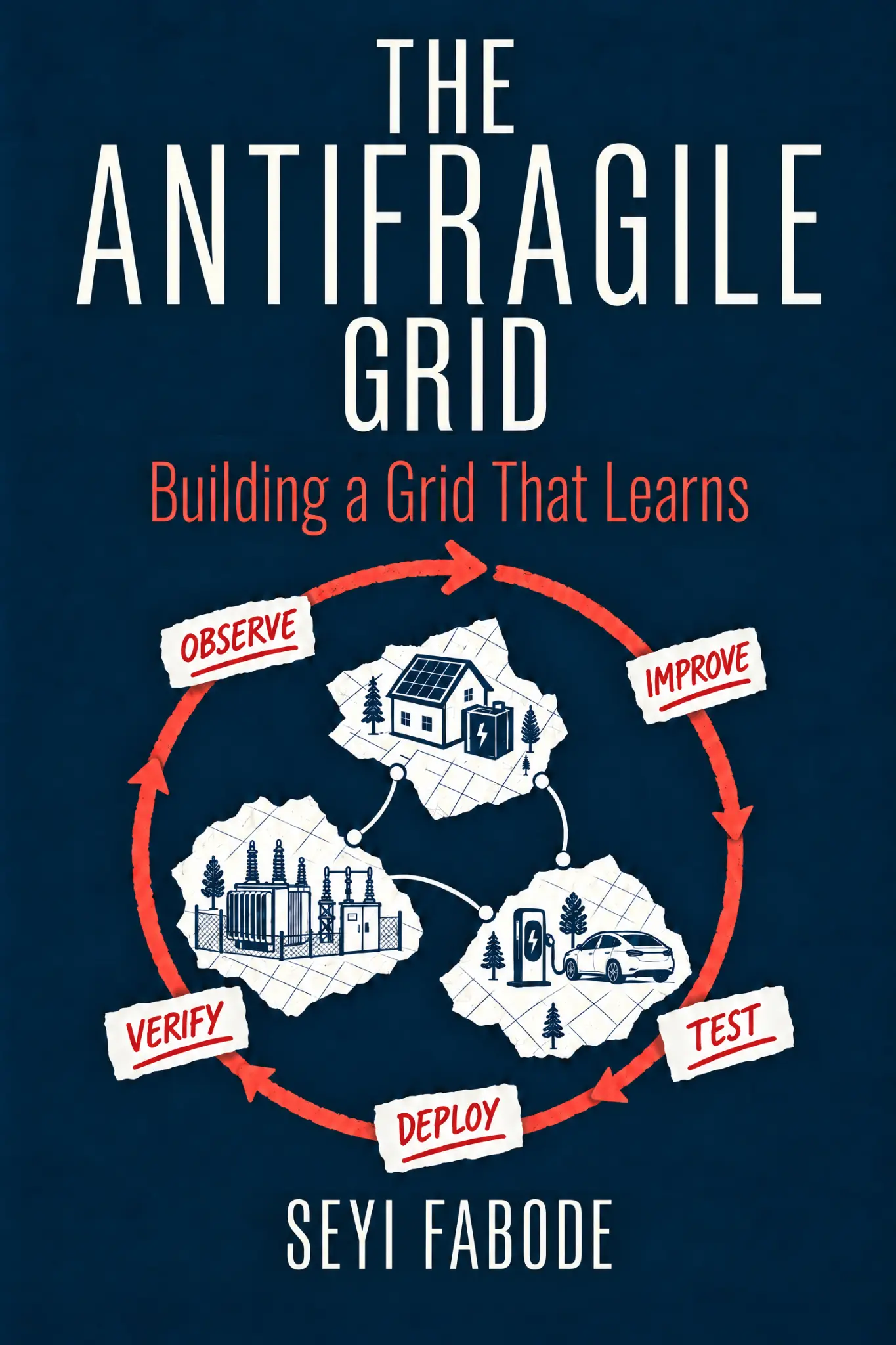 Not just stronger.
Smarter after stress. OBSERVE / IMPROVE / TEST / DEPLOY / VERIFY The updated book · Seyi Fabode
The argument
We keep rebuilding
the grid.
What if we
taught it to learn?
Homes produce power. Batteries store it. Vehicles and buildings can shift when they use it. The grid’s edge is no longer just a destination. It is an active part of the system.
But more devices don’t automatically make a better grid. The real task is to coordinate them with the wires, operators, and institutions we already depend on.
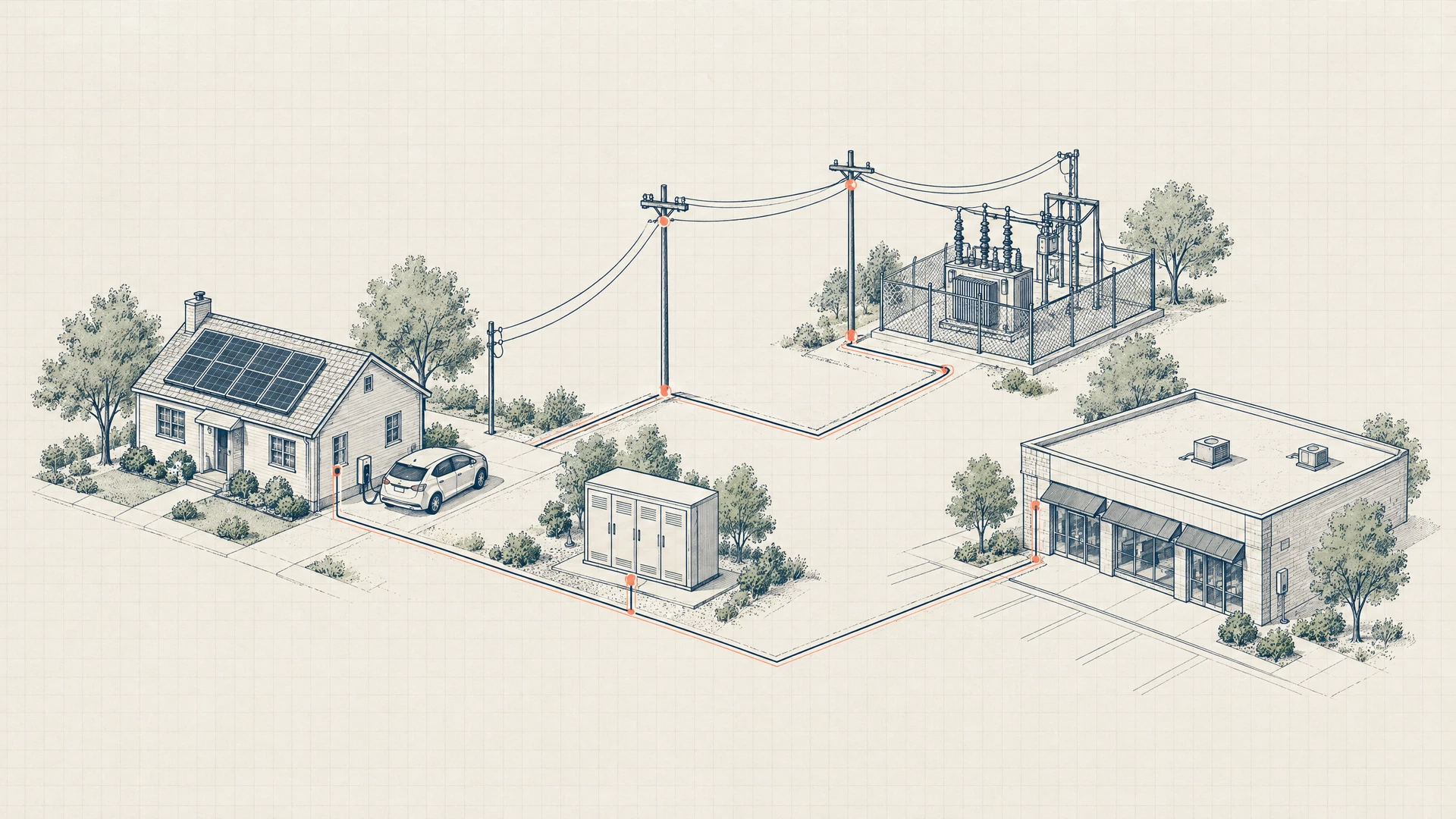
A network. Not a free-for-all.
Start local.
Think in nodes.
An energy node brings local generation, storage, flexible demand, measurements, and controls into a known operating boundary.
A neighborhood. A campus. A hospital. Each can offer useful flexibility—but only within its actual electrical limits, customer permissions, and operating authority.
A node is not automatically an island. A virtual power plant, a microgrid, and an energy node are different things.
The learning loop
Learning isn’t a feature.
It’s an operating discipline.
Keeping an incident log isn’t enough. Experience must become a tested, approved change—and the result must be measured.
See what the system actually did.
Compare forecasts with measurements. Understand battery availability, feeder conditions, customer participation, and the sequence of events. Make uncertainty visible before adding autonomy.
The disciplineBetter visibility.
Not
just more data.
Turn a finding into a proposed change.
Diagnose the gap between expected and observed performance. Propose a revised forecast, reserve policy, control setting, operating procedure, or equipment investment. A model’s suggestion is not permission to operate.
The disciplineDiagnose first.
Change
with purpose.
Test the bad day, not just the sunny one.
Use engineering review, simulation, and controlled trials. Check failed communications, inaccurate forecasts, synchronized device responses, protection behavior, and restoration. Define the safe fallback before automation.
The disciplineEvidence before
operating
authority.
Release a bounded, approved change.
Deploy in stages with versioned records, clear authority, operator overrides, and a rollback path. Local protection and customer safety limits remain in charge—even when a wider system asks for more.
The disciplineClear limits.
A way
back.
Prove the next response is better.
Measure results against a credible baseline under comparable conditions. Track restoration, delivered flexibility, forecast error, violations, and community benefits. Feed verified outcomes into the next observation cycle.
The disciplineMeasured improvement.
Then
repeat.
The objective is fewer failures and better decisions—not outages in the name of learning.
Inside the update
A vision with
its feet on
the ground.
From the physics that software cannot repeal to the institutions that make coordination possible.
Read the openingLEARNING ALWAYS.
01
Start with the physics
Power and energy. Frequency and voltage. Thermal limits and protection. Why where, when, and for how long matter as much as how many kilowatts.
02
Define the energy node
A practical operating boundary for local assets. Understand what distinguishes an energy node from a virtual power plant and a microgrid—and what islanding really requires.
03
See before you automate
Trustworthy measurements, calibrated network models, and state estimation with visible uncertainty. More data is not the same as better situational awareness.
04
Coordinate across time
Look-ahead scheduling and network-aware control. Plan for reserves, customer needs, forecast error, and the rebound that follows deferred demand.
05
Control at the right level
Devices protect themselves. Nodes manage local limits. Distribution operators preserve the wires. System operators balance the wider network. Authority matters as much as speed.
06
Learn from a real event
Follow an extreme-heat evening and storm threat from preparation to fault isolation, safe restoration, and a post-event review that changes the next response.
07
Face the constraints
Common-mode failure, uncertain capacity, inverter interactions, cybersecurity, privacy, incentives, cost, and equity. A workable architecture does not skip the hard parts.
08
Build a credible pathway
Establish a baseline. Make flexibility visible. Test bounded controls. Federate successful nodes. Close the learning loop with evidence, not claims.
Themes from the updated book outline / expand to explore
If you have skin in the grid
For the people
responsible for
what happens next.
-
01
Utility leaders and operators building dependable systems.
-
02
Energy builders turning distributed assets into useful flexibility.
-
03
Policymakers and investors weighing infrastructure decisions.
-
04
Communities who deserve a say in how resilience is built.
The Antifragile Grid / the updated book
The next shock
shouldn’t teach us
the same lesson.
Build the systems that can observe, coordinate, and improve—without compromising the physics or the people they serve.
Read the opening
Updated-edition availability to be announced.
Retailer
details will be added when confirmed.
MORE LEARNING.
BUILDING A GRID THAT LEARNS